About Ethanol
Sugarcane Factory - Upcoming Project Perl Solution
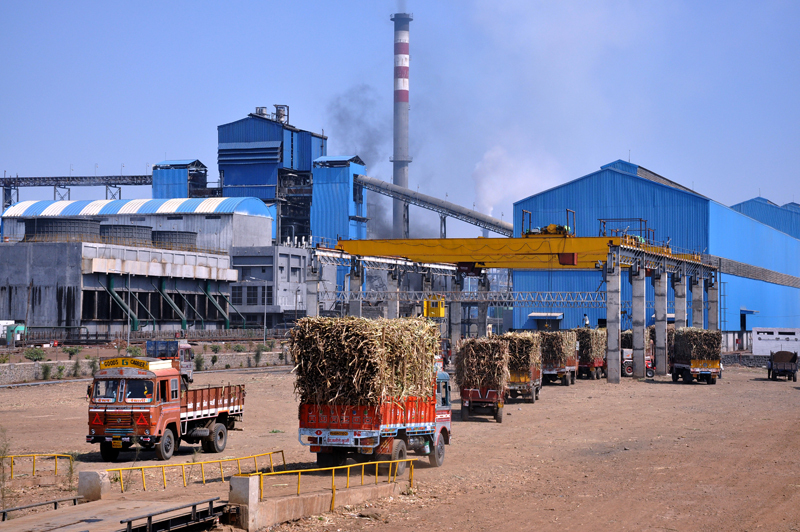
Sugarcane Factory
Although world prices for sugar and petroleum products have shown spectacular variations since 1973, the long term outlook is very likely to be a gradual increase in the price of all fossil fuels and stagnation, at best, for the price of sugar. This gloomy prospect explains, to a large degree, the renewed interest in the byproducts of the sugarcane industry which has developed in the last ten years and which has shown that the optimal use of byproducts can provide a non-negligible support to the sugarcane industry, although it could not, by itself, completely redress the difficult situation sugar is presently experiencing.Reliable statistics are not available to show the detailed end uses of these byproducts on a world basis, but although their utilization will be considered later in more detail, as a very rough picture of their trade we can say that at present cane tops and filter muds are largely ignored; that bagasse is used internally mainly as fuel to generate steam in the sugarcane factories and a small fraction to produce pulp and board; and that molasses is exported either as such for animal feed or after transformation as rum, potable alcohol or industrial alcohol.
Reliable statistics are not available to show the detailed end uses of these byproducts on a world basis, but although their utilization will be considered later in more detail, as a very rough picture of their trade we can say that at present cane tops and filter muds are largely ignored; that bagasse is used internally mainly as fuel to generate steam in the sugarcane factories and a small fraction to produce pulp and board; and that molasses is exported either as such for animal feed or after transformation as rum, potable alcohol or industrial alcohol.
‘It should be pointed out that, as a general rule, maximum value upgrading goes with more complex processing characterized by capital intensity, sophisticated technical know how and competitive markets. Maximization of profits is not automatically linked with process complexity and depends much more often on advantages local conditions or the proximity of a remunerative export market.
Although “small” may be rarely “beautiful” when dealing with byproducts, the simpler operations are often the more profitable.As an example, molasses can simply be exported as such and earn some US$ 25 to 30 per tonne. However, by transforming the molasses into citric acid (worth say US$ 1 600 per tonne) about 330 kg of citric acid worth US$ 528 would be obtained from one tonne of molasses, i.e. about 18 times more than the previous operation. We must point out however that it is generally much easier to find a market for 30 000 tonnes of citric acid (worth US$ 750 000) than it is to find a buyer for 10 000 tonnes of citric acid (worth US$ 16 000 000). The market price of the byproducts of the sugarcane industry varies from country to country with cyclical increases and decreases. Cane tops have no real market value. They can be compared to fair quality fodder with an average feed value, when fresh, of about 2.8 megajoules of metabolizable energy per kilo of dry matter. However cane tops should be collected and transported from the cane fields to the feedlot and their value to the cane producer could probably be no more than US$ 10 per tonne of fresh cane tops.The price of bagasse is generally related to its fuel value. Thus since 1 tonne of mill-run bagasse can be replaced by 0.173 tonne of fuel oil, worth US$ 80/tonne or again by 0.263 tonne of bituminous coal worth US$55/tonne, it can be said that bagasse is worth between US$ 13.8 and 14.5 per tonne (mill-run weight, 50 percent moisture content) and a figure of US$ 15 can be used as a rounded representative average.Filter muds have no set market value and since they are used almost exclusively as fertilizer, it is reasonable to utilize their fertilizer value which stands at present at about US$ 10 per tonne of air dried filter muds (30 percent moisture).Molasses is traded on the international market and its price fluctuates appreciably from year to year. The average FOB price New Orleans for 1985 was US$ 64.33 per tonne (at 79.5° Bx).
Contact Us